Both Autodesk and Airbus are dedicated to pushing the boundaries of advanced technologies in the pursuit of innovation and a more sustainable world. So, it should come as no surprise that the two companies are teaming up to fundamentally change how things will be manufactured and built in the aerospace industry of the near future.

An Airbus wing factory.
See how generative design is inspiring the future of space exploration.
As part of an ongoing effort, Airbus is reimagining multiple structural aircraft components, applying Autodesk generative design to develop lighter–weight parts that exceed performance and safety standards. In an industry where less weight equals less fuel consumption, using this approach presents a huge opportunity to reduce the adverse effects of air travel on the environment. Airbus is also looking beyond airplane parts to the processes and spaces for making them, employing generative design for the layout of adaptable, DGNB and LEED certified factories with streamlined logistics to facilitate improved employee work conditions and greater productivity.
Bionic Partition 2.0
Back in 2015, Airbus unveiled its first generative design proof-of-concept. The “bionic partition” is a next-generation version of the wall and jumpseat support structure that divides the passenger compartment from the galley of a plane. The initial design was promising – 45 percent lighter than the traditional part yet just as strong. Airbus estimated the new design approach could save nearly half a million metric tons of CO2 emissions per year if rolled out across its backlog of A320 planes.

Airbus workers test placement of the bionic partition.

A 3D print of the generatively designed vertical tail plane
Factory of the Future
Positive responses to what generative design could do for aircraft components led Airbus to explore what the technology might do for other parts of its business. Earlier this year, the team began thinking about how generative design could be applied to the building design, layout and workflows of its factories. First, they looked at an assembly line for A350 wings where a significant amount of human labor and several different tools are required. The objective was to figure out how a single factory bay could be configured for multiple wing variations from the different generations of the A350, with optimal tool locations and travel paths, and minimal congestion and bottlenecks. Airbus is now turning its attention to possible concepts for using this technology in other production hangars in the future. The goal is to ultimately assemble engines more quickly with more efficient logistical flows and a more content workforce, in a factory that is expandable and adaptable to meet Airbus’ needs both today and in the future.

An Airbus engine.
- Lot Efficiency – total amount and proportion of usable left-over space inside of site boundary and outside of building footprint
- Construction Cost – features critical in estimating building construction cost, including total building footprint, number and size of unique structures, and area of various materials used on the façade
- Sustainability – features critical for DGNB/LEED certification, including green roof deck for employees, building acoustics, thermal comfort, biodiversity zones, permeable surfaces, and bicycle parking
- Employee Work Conditions – distance from workstations to restrooms (to be minimized); and views to outdoor green areas from meeting rooms, coffee bar, break rooms, and kitchen
- Logistics Flow / Paint Flow / Engine Flow (three separate constraints) – flow paths between stations along the production sequence
- Customer Experience – views from lobby and other customer zones to both assembly stations and outdoor green area
- Daylight – amount of natural diffuse light in critical spaces for office, production, and customer experience
- Flexibility – potential for the building to expand in the future, especially within the original site boundary
Generative design provided two paths that Airbus is currently considering: a bigger building with an unconventional footprint, or the same factory elements optimized to fit into a smaller rectangular footprint. “Generative design is helping us create a more sustainable architectural design that better accounts for critical human factors and work conditions,” said Schaefer. “It has also expanded our way of thinking and our approach to design by overcoming preconceived notions and blind spots. Whichever design we choose, we know the factory will function more efficiently and will be less costly to build.” For Airbus, it appears the future of making and building has arrived.
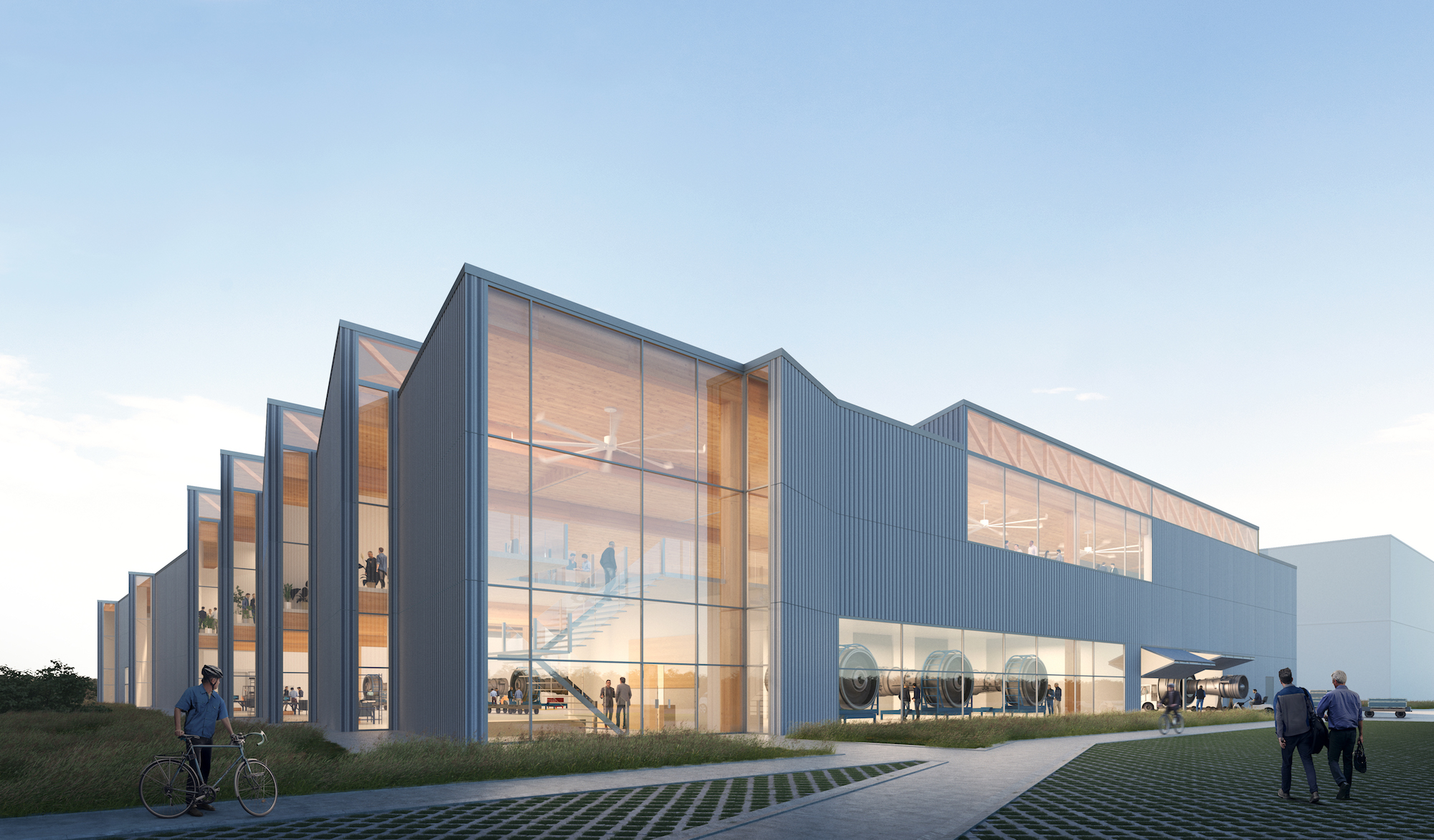
A rendering of the Airbus engine assembly factory.